Cultural Product

Cultural Product
Serving Suggestion
Showing posts with label Installation. Show all posts

Wednesday, April 22, 2015

City of Plenty

Three years ago, when working on Plastici at Margot Lewer's home in Penrith, Lee-Anne Hall the director spoke with me about doing a project. This year it became reality. It has been documented by the students at Caroline Chisolm High School on this blog I was fortunate enough to have the great pleasure of assembling and arranging the donated works... For real, usually I go out seeking/collecting/gathering, THIS TIME IT CAME TO ME! What is more, at the end of the project it was donated to Penrith Community Kitchen, and Oz Harvest...benevolent goodwill...over $20,000 in non-perishables were donated, and much as I would've liked even more, I felt like I was the beneficiary of way more.

Monday, April 20, 2015

HERE

Kandos windows, winter 2014 On residency in preparation for Cementa_2015

Saturday, June 21, 2014

Pinterest

Fairfield City Museum and Art Gallery exhibition "Strange Histories" Bottom piece; a simulation of the notice board in the General Store, with additional material Materials: Watercolour, plastics, tracing paper, biro, ribbon, felt, thumb tacks, digital print, sellotape, photograph, paper. Top piece; a tracing of an Islamic prayer rug, soldering iron on builder's plastic, mounted on black painted board. I just found my artist statement; My work centers around the transformation of objects, re-fashioning the world in a consumer context. I work site-specifically, in installation, collecting materials and converting spaces. I collect objects that are reminiscent of the site’s history and ethos, making a work that describes a sensibility and affinity with the area, as observed. Various collections of objects and materials emerge in the process and are placed within the Gallery context. The sculptural work, Fair field is a new piece consisting of a large doll’s house, constructed by the artist Kevin Sheehan for his daughter, Mila. I have appropriated the house and made additions, converting it into an artwork. Today’s current sense of progress invokes a variety of metaphors which I can only describe as re-scheduled. Notions of the original seems steeped in nostalgia, which I’m not adverse to. In fact, I value the authenticity of any original, and attempt to make it my own. As an artist, these narratives come into play. The wall work consists of a copy of the notice board Pinterest at the General Store, using water colour paintings of commercial packaging/postcards/receipts, digital copies of drawings and mock-ups, representing the culturally diverse flavours of Fairfield.

Friday, June 20, 2014

New Digital Media

Sarah Goffman transforms the prosaic, the banal and the mundane. In the way of a latter day alchemist she turns cloned plastics and packaging, the discards and neglected items of consumerist, throwaway cultures into unique, decorative objects of desire. The repurposing and hand fashioning is apparent in the wry but apposite title, ‘new digital media” given to her latest group of works. She has been working with plastic and collecting and reinterpreting everyday items for over twenty years and immersing herself in Asian cultures, particularly in Japan. Since 2009 she has undertaken artist residencies under the auspices of Asialink and the Australia Council and worked and exhibited with contemporary artists. Many of her works are a fusion of Asian and Australian sensibilities she describes as “…being derivative of a Silk Road ethos, via China and Japan to Australia, of taking found objects or discarded materials and transforming them into beautiful and precious things.” Sarah Goffman’s approach can be likened to a form of visual Chinese Whispers. A shelf installation of line drawings in blue marker pen on Mylar, was conceived for this exhibition while leafing through a Japanese digital technology catalogue. One panel suggests a computer motherboard, but it and other of the drawings are all traced in the style of blue and while Willow Pattern ceramics and Chinoiserie textiles. A lo-fi video, a painterly, scanned video-scape of merged and blurred surfaces, some shiny some matte, all rich reds, is shot in the streets of Sydney. But this abstract vision is greatly distanced from the detailed and articulated assembly line engineered machinery and sleek commercial advertisements for the ultimate consumer object of desire that is the red car. Sarah Goffman’s practice spans, painting, drawing, sculpture, video and performance. Integral to all aspects is the philosophical conundrum of “When does one thing cease to be itself and become another?” Her assemblages describe an historical materialism and a legacy of visual exchange across cultures marked by an underlying quiet but potent and subversive irony. Barbara Dowse Curator

Wednesday, December 4, 2013

Maximalist Tokonoma

At Gallery9 Something old, something new...

Sunday, September 29, 2013

Hard Rubbish 2013

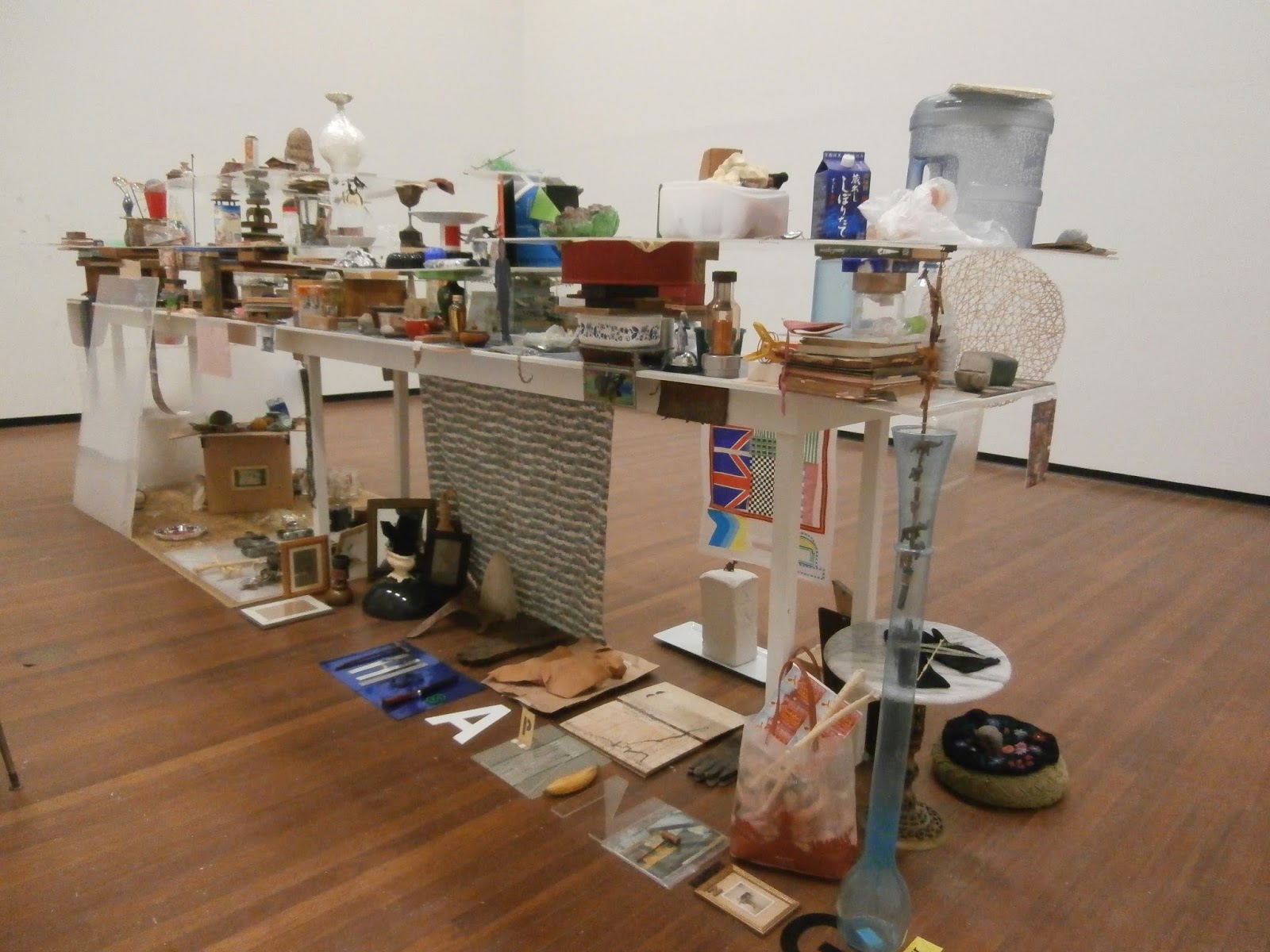
As part of the exhibition Camouflage at Sydney College of the Arts. This piece contains found, made, collected, altered and assembled material objects. There were 450 items in total.
On the floor I spelt out "THIS IS A PAINTING" in objects.

Saturday, December 22, 2012

The answer my friends is blowing in the wind

This week I had the fortune of installing my show at Margo Lewer's house in Penrith, for a solo exhibition titled Plastici. This show has been a long time in the making and was a delight to complete in this wonderful house, bequeathed by the wondrous Margo in 1978. The exhibition entails the works I'd made at Tokyp Wonder Site last year, on my Asialink scholarship, and further developed in Yokohama with Bec Dean as part of Life 3 by Bank Art at Shin-Minatomira. And finally completed here. I found the resolution of the works relatively easy, as the Gallery's resources provided exactly what I needed; re-inforcing my precepts concerning synchronicity. In fact, once again, during install I was comforted by the magic of things fitting together and trusting my intuition to a deep level. I would sit out in the garden, and a leaf would fall. Nature always delivers if you wait for long enough. Suffice to say, this was the best show I've ever done and the most amazing venue to install in. I felt a deep connection with all the other artists I've ever seen exhibit here or anywhere for that matter, as their work informs mine and we all do what we have to do. Art is wonderful, creating is wondrous, and being an artist sometimes makes me feel like the luckiest person alive. Plastici comes from a journal, I think by the same title that Georgio Morandi worked on in the early 20th Century.
Valori plastici was established in Rome by the painter and art collector Mario Broglio (1891-1948) in 1918.[1][2] He also edited the magazine which focused on aesthetic ideals and metaphysical artwork. It supported the art movement Return to order so as to create a change of direction from the extreme avant-garde art of the years up to 1918, taking its inspiration from traditional art instead.[3] The term "return to order" to describe this renewed interest in tradition is said to derive from Le rappel a l'ordre, a book of essays by the poet and artist Jean Cocteau published in 1926. The movement itself was a reaction to the War. Cubism was abandoned even by its creators, Braque and Picasso, and Futurism, which had praised machinery, violence and war, was rejected by most of its followers. The return to order was associated with a revival of classicism and realistic painting. The magazine theorised the retrieval of national and Italic values, as promoted by the cultural policies of fascism, but also looking at wider horizons within Europe and using a vivid artistic dialectics with a return to a classic figurative source. Alberto Savinio,[4] in the 1st issue of Valori plastici on 15 November 1918, announced a programme of total individualistic, anti-futurist and anti-Bolshevik restoration. In his first article of April–May 1919, entitled Anadioménon, Savinio expounds the intellective and enigmatically atemporal intuition which animates the world of this new "metaphysical classicism".[5] The Savinian principles on mataphisical poetics are applied to painting by Giorgio de Chirico, by Carlo Carrà and Giorgio Morandi.