Cultural Product

Cultural Product
Serving Suggestion
Showing posts with label Collections. Show all posts

Wednesday, April 22, 2015

City of Plenty

Three years ago, when working on Plastici at Margot Lewer's home in Penrith, Lee-Anne Hall the director spoke with me about doing a project. This year it became reality. It has been documented by the students at Caroline Chisolm High School on this blog I was fortunate enough to have the great pleasure of assembling and arranging the donated works... For real, usually I go out seeking/collecting/gathering, THIS TIME IT CAME TO ME! What is more, at the end of the project it was donated to Penrith Community Kitchen, and Oz Harvest...benevolent goodwill...over $20,000 in non-perishables were donated, and much as I would've liked even more, I felt like I was the beneficiary of way more.

Sunday, January 4, 2015

Vibrant Matter

At The Bearded Tit, Redfern Emma Price asked me to do the window of the bar, and in response to the surrounding area and Jane Bennett's wonderful book https://www.dukeupress.edu/Vibrant-Matter/, I installed a hodge-podge installation...haha you can see my fat feet in the bottom photo...

Sunday, September 29, 2013

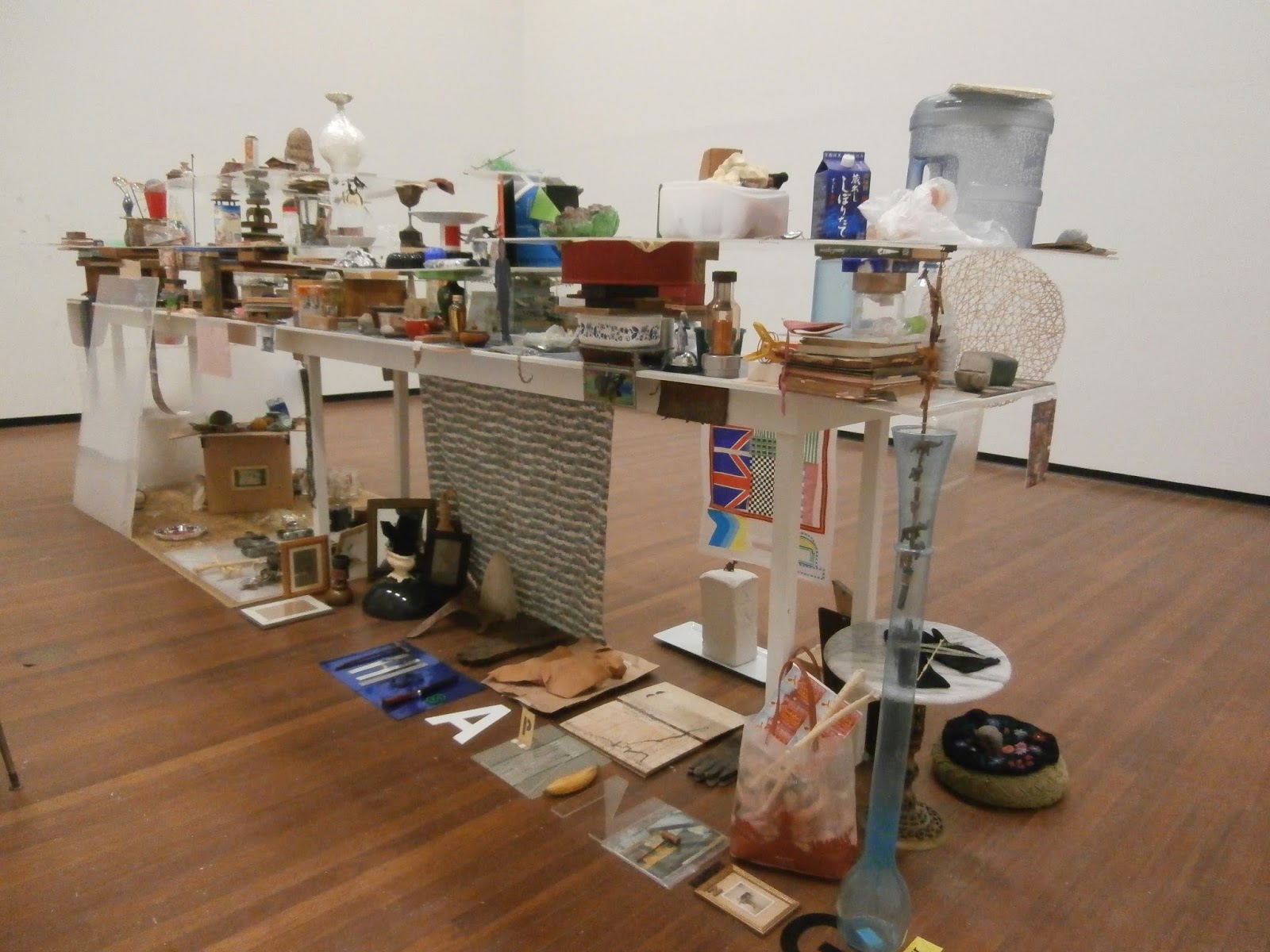
Hard Rubbish 2013

As part of the exhibition Camouflage at Sydney College of the Arts. This piece contains found, made, collected, altered and assembled material objects. There were 450 items in total.
On the floor I spelt out "THIS IS A PAINTING" in objects.

Saturday, April 20, 2013

Seven Days of Packaging

I collected the packaging of various foods I consumed and made a self portrait, using watercolours.
Photo: Jessica Maurer “I am supposed to be what I read, what I listen to, what I look at” Bourriaud, N. 2002 POSTPRODUCTION Lukas and Sternberg, New York “I am what I am attached to” Latour, B. 2012 An Inquiry into Modes of Existence: An Anthropology of the Moderns Harvard University Press, Cambridge Massachusetts “You are what you eat” Anthelme Brillat-Savarin wrote, in Physiologie du Gout, ou Meditations de Gastronomie Transcendante, 1826 “It is this mysterious force called life that is responsible for “thoroughly transforming” the edible object…into the eater” Bennett, J. 2010 Vibrant Matter: A Political Ecology of Things Duke University Press, Durham North Carolina

Friday, December 10, 2010

Trashcan Dreams

___________________________________


October 2010
Trashcan Dreams at The Performance Space
with dancers Morisan Yasuaki and Lina Ritchie
The title comes from an Elton John song; Mona Lisa and Mad Hatters
There were many elements to this exhibition, primarily I was responding to the site with my collection and with pieces that would provide an environment to respond to. The dancers, from Japan, worked in collaboration with the materials, over a nine day intense period, where we explored a huge variety of movement.
The work consisted of vast quantities of plastic collected over the last ten years from my local neighbours and friends. Many of the plastics were re-cycled from other exhibitions, being re-fashioned for this event.
The piece I am most proud of; Kyoto copy was made entirely of plastics and is a literal copy of a piece I saw in Kyoto in 2009.


Working with colour, materials, video and objects, interacting with the space and reacting to site-specific as well as historical contexts within the site.

Rectangular dance workshops with participants

Wednesday, May 14, 2008

Some More

1. Found pencils

2. Found erasers
3. Tally ho numbers 1-42
Each part of the gallery gets treatment. After five days this work that you see, was all I could do, but on Saturday when I mind it, I can fiddle and add. I would dearly like to have a space for one year and go all the way. Install process is fantastic, I can't find a better high than finding a place for every thing, and the connections that are made between objects. Sometimes when I am placing things, I feel like there are all these extraneous elements that just act as supports for the one true and dear thing. It is up to the public to enjoy those relationships and find them for themselves.

Monday, October 1, 2007

Plastics


Here is my plastic bag collection.
Photo: Margaret Roberts


  1. I love the way plastics can be bundled up, and squashed, then laid out again and re-flattened. They have a memory, physically, and can become impregnated with scents. I notice very few used bags in our affluent society. Occasionally someone on the train will have their trusty favourite that they use regularly, and you can see how the colour has evaporated around the handles, however it is quite rare.
  2. I was asked recently why I focused on plastics. Perhaps because I grew up in the USA and was a victim of polyester! For sure because of the environmental impact, but also because they symbolise our affluence, and neglect as well. But growing up in New York city in the 70's and 80's there were various artists who made sculptural works in abandoned lots, using garbage they'd create fantastic art works. I found these very inspirational. I would watch the barges go down the East River laden with millions of bags of rubbish. Even as a child I was incredulous that these got dumped out at sea. Sick! The synthetic nature of petrochemicals and their impact on our everyday life is one that I am examining.
  3. Maybe Christo has something to do with it? Or Jeff Wall? Later, in the 90's I saw work by Mikala Dwyer and Hany Armonious. I knew I was amongst friends. Nowadays I can list dozens of artists, just locals who work with the stuff, and I love it. Anne Kay! Josie Cavallaro! Lisa Kelly! Kathy Cavaliere! Simon Yates! Simon Cavanough! Nick Strike! Caz Haswell! Jason Markou! Michelle Hanlin!

Saturday, January 1, 2005

Elastic archive show


At Cross Art

Elastic Projects was invited to put together a show for Cross Art, run by Jo Holder. Elvis Richardson, Lisa Andrew, Anne Kay and I curated this show of works made in the context of archives.

I curated a video programme, and wrote a booklet. I also invited people to my home for tea.
Installation view by Regina Walters
pictured; Liz Day, Liz Pulie, Elvis Richardson
The Gallery as Archive 2005

I identify with collecting for a number of reasons, but mainly because I admire other people’s collections. As a child, my family moved countries a number of times, and with each move, more things would get lost or broken. The notion of hanging on to something for a good long time was unknown. Even the most valuable things can disappear. When I returned to Australia, nearly 20 years ago, I only had two suitcases with me. It’d been my policy to be able to move myself, requiring only a taxi. Since then I have been able to stay put and bring home as much as I can find, within reason. My partner PJ and I trawl the streets for throwaways, collecting what others don’t want. Neither of us can believe what good things people put out on household rubbish collection days.

Collecting and Ownership
I remember being awestruck by giant mountains when I was young, and felt more than a sense of wonder. I felt a desire to own those mammoth things, to contain them, and somehow have access to that majestic beauty forever. Short of climbing them and living there, I felt some satisfaction by doing a drawing, and then I felt like it was in my heart, or at least in my sketchbook. My home and studio space are my archive, and are constantly in use and being improved upon.

For the Elastic archive show I wanted to assemble a collection of video works that dealt with collecting. I liked the idea of using the minute storage facility of the DVD to serve as such a fantastic recording device, holding potentially loads of information. This contrasts so heavily with my work, and my home, which serves as my archive.
The Gallery as Archive show initiates my quest for video works that deal with collecting in some way. Hopefully, this will be the beginning of an archive of video works that attempt to catalogue the notion.

The pre-occupation with gathering together, archiving, storing and collecting seems inevitable. Relatively little from the distant past remains, so we seem to be on a mission to preserve remnants, souvenir our culture, to the death! Who decides what is kept, and what is thrown away? Bart Simpson nearly killed for a comic book. A giant air controlled hangar filled with Sydney 2000 Olympic records exists! I’d prefer to see a museum filled with snapshots taken at Olympic events, by visitors, actually. E-bay acts as the largest catalogue collection in the world. Sci-fi writer William Gibson observed this obsession with thrift-shop hunting and picking may be a sign of “some desperate instinctive re-configuring of the post-industrial flow, some basic mammalian response to the bewildering flood of sheer stuff we produce”.
[1]

Regina Walter’s video ‘IN’ is a collection of images of women taking a puff from a cigarette. The camera acts casually, outside a plaza and often there’s an embarrassingly candid gaze of the smoker, as you’re watching them inhale. Magnifying through repetition. The simplicity of gathering together groups of sames appeals to me psychologically seeking order in chaos, but also because it makes you look at those moments with a different concentration. After analysing something, you are much more involved with it. In ‘Smithfield’, the idea extends to asking passer-byes to say “Smithfield”. The random choice of people, and their genuine personalities, as well as their enthusiastic, almost ritualistic boredom makes me feel glad. I see some reflection of myself in those residents, and their quintessentially Australian dynamic is apparent.

Kutlug Ataman’s Küba, shown this year at the Argyle Centre served as an amazing installation of Istanbul resident’s stories. I loved seeing the work, for it’s obsession with tragic stories, fringe residents (they looked like my kind of people), and also it’s physicality. The collection of well-worn Salvation Army armchairs, old televisions, and TV tables had to be experienced, to be believed. The warmth and cosines of those very domestic objects, all varied, making a giant living room out of the old wooden wool store building, and eerily one chair per monitor, all facing South-East (?).

Liz Day’s work The Origin of Ideas is an ongoing inquiry into these places where thought processes meander. An interdisciplinary archive of notebooks showing the intimate working processes of people working across arts and sciences. She records random sequences of sketchbook pages, and as you watch, the sense of following each artist’s neural pathways is evident and delightful. The translation of paper through to video is quiet and fluid. The assemblage of people’s works, and just a taste of a few of their books have a sensibility that achieves so much through passive contemplation. I felt the seminal act of creation was evoked, and made the ordinary quite beautiful. Private jottings and notes are scanned as quickly as a complex drawing or configuration. I watched my own with trepidation, but feel honored to be included. She has been working with other people’s notebooks since 1997 and has a further work planned for later this year, in Tasmania.

Che Guevara’s image lives on in Raquel Ormella’s zines Che 2005. This document of his ever-increasing popularity demonstrates a fortitude, commitment and readiness to record each and every image of Che that came her way over 10 years. The revolution seems to have only begun and his face is everywhere! I think she even culled her collection to keep the costs of printing down. If only Gandhi was as photogenic… The pre-occupation with the subject seems devotedly fan-like, as that’s what is required for a collector. Time is of the essence when you’re collecting. You can go to e-bay and purchase a ready-made collection, but marking time through you pursuit historicises a life’s journey.

When I invited Luke to do something for the show, he wanted to display some aspect of his collection. Mark wearing my t-shirt collection 2005 reminds me of Brigid Berlin’s substantial pile of identical Lacoste© t-shirts from the Pie in the Sky documentary. It didn’t matter how ragged they were, they had done their time and it was integral they were there. Luke’s photographs document a devotion to interesting t-shirts, handsomely modeled by Mark. I admire obsession. It is the commitment that keeps the collection alive. The devotion over time seems somewhat religious to me, I know how enthralled I am, when I find a thing that compliments my collection. Once I have a number of similar items, and they really start mounting up to something, I pore over them with pleasure. Accumulating a substantial collection can make a person famous; someone I knew, knew someone who sold their ABBA scrapbooks to The Powerhouse Museum for $10,000. I wonder if anyone will ever want my collection of tobacco-related paraphernalia!

A couple of years ago I was given some watercolours and I embarked on a series of paintings of packaging I’d amassed. I filled a book with quaint paintings, in the hope that I wouldn’t have to keep all the empty packages forever, that the painting would serve as a record, and that was enough. Unfortunately, when I looked at the paintings on their own, they weren’t as interesting as when they had the object next to them. At art school, studying painting, I was confounded by the length of time it took to paint something reasonable. I moved into photography, where capturing things on film takes a millisecond, but stills weren’t enough.
[2] I went back to the objects themselves.
So, for my own work, I would like to invite visitors to my home, open by arrangement in November.
‘In perpetuity’ seems impossible as I consider our population, era, environment, and history.


[1] William Gibson, “My Obsession”, Wired, January 1999, 102
[2] The removal of the object through photography, and the distance created between the viewer and that original object seems distorted to me. The interruption, or lie of the lens is an easily manipulated tool. How to display photographic works dictates their interpretation. It can be an expensive medium.

Friday, January 2, 2004

The doctor is in

Bus ticket collection
Printed numbers in water


I collected Metro Ten tickets because I liked that they printed out the exact time of the transaction. I used the services of Column 8 in the Sydney Morning Herald to acquire more tickets. I found there were other people who had been collecting for years. I wanted to map out every minute of every hour of the day that the buses run. I cut out the time and pasted it on to sticks, shown here. I never completed every minute of the day, but I got close. I think they matched the ghastly laminex counters in the gallery.